
Judikit logoJudikit

Legal help, just a tap away.

Judikit connects you with Bar Council-verified advocates across India for property disputes, criminal defence, corporate law, family matters, and more.

OR
Available Now
Coming Soon
Need legal guidance

Need a lawyer in India?

Property disputes, criminal cases, corporate law, family matters. Judikit connects you with the right verified advocate, fast.

Legal Services Built for
How Indians Actually Live

From property disputes and criminal defence to corporate law and alternative dispute resolution. Find the legal help you need, where you need it.

Legal Advice & Consultation

Find and connect with verified advocates across India in minutes. Whether you need initial legal advice for a property dispute, guidance on a criminal matter, or an experienced advocate for ongoing representation, search by city, court, and practice area to find the right expert.
Finding the right advocate used to be a nightmare. Judikit matched me with a verified property lawyer in Delhi within minutes. Clear advice, transparent fees.
Vikram S., Property Dispute Client, Delhi
Legal Advice & Consultation

Case Tracking & Management

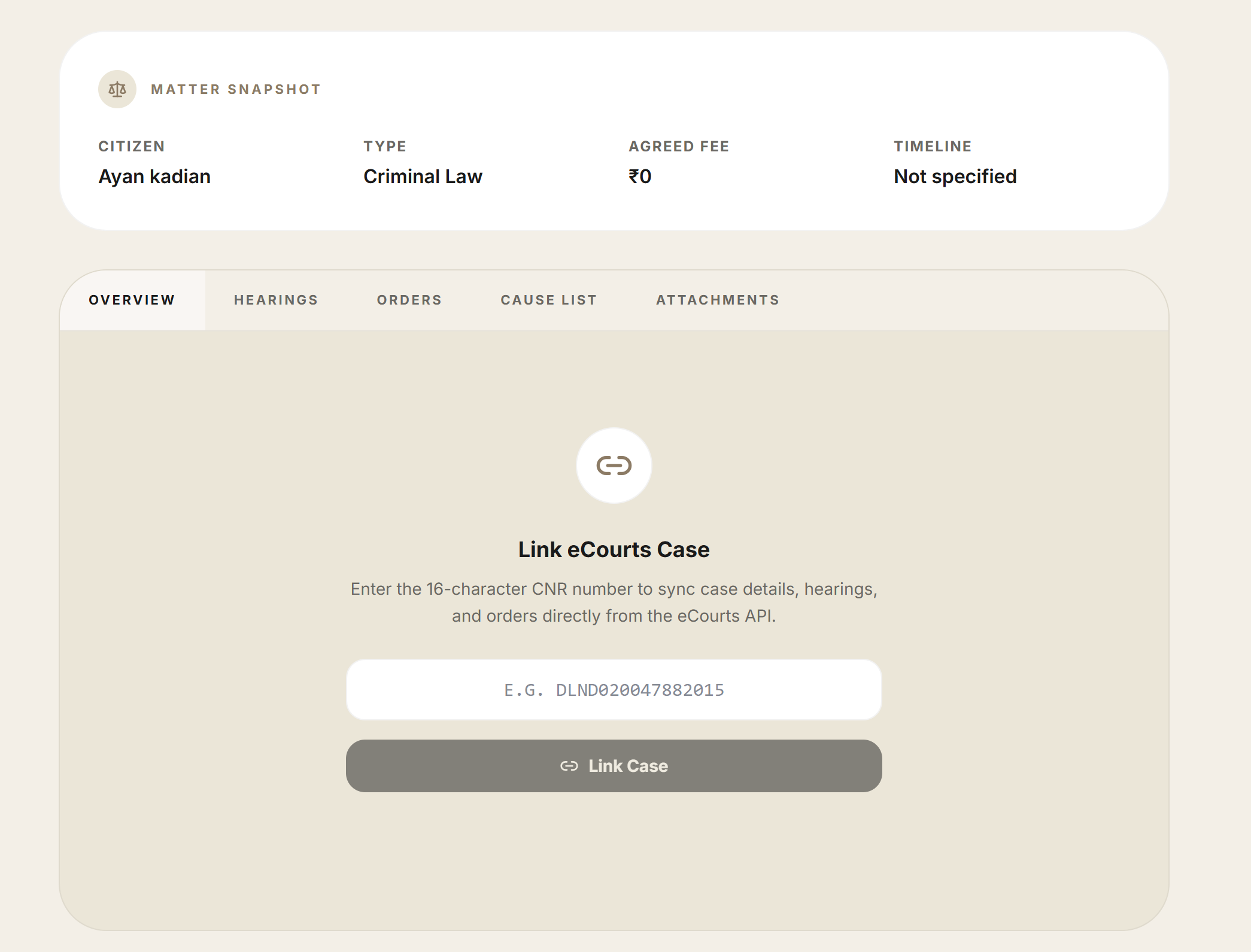
Never miss a High Court or District Court deadline, never lose a document, and never leave a client wondering what's happening with their case. Judikit's practice dashboard keeps your calendar, case files, and client communication in one place, so your reputation stays solid and your clients stay informed.
As a corporate lawyer handling multiple clients, Judikit's case management dashboard keeps every hearing, document, and client communication in one place. A complete game-changer.
Aarav M., Corporate Advocate, Mumbai
Case Tracking & Management

Law Student Mentorship & Internships

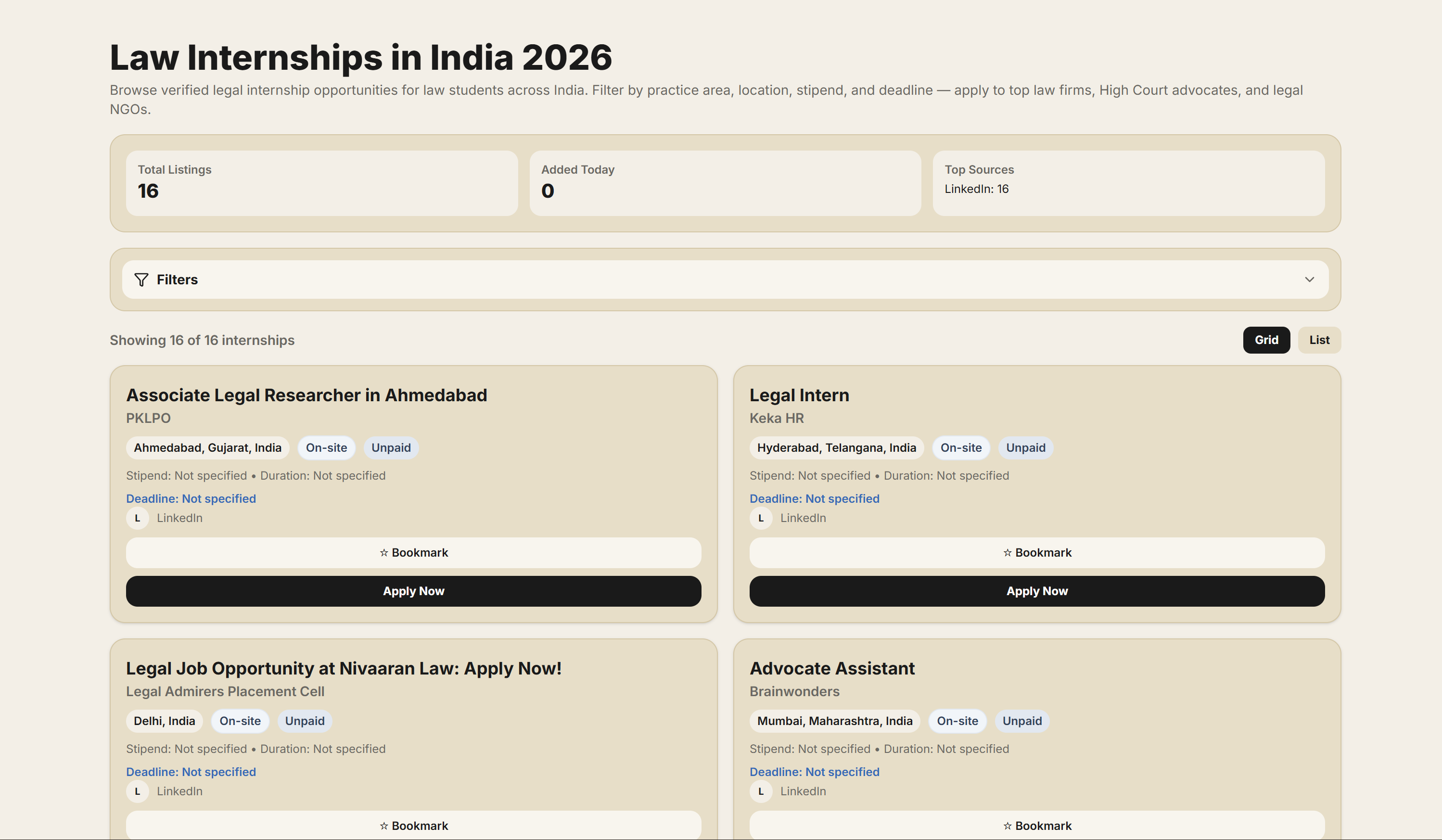
India's dedicated career platform for law students. Access curated CLAT and AIBE study resources, apply for verified internships with Supreme Court and High Court advocates, and learn from experienced legal professionals through our mentorship forums.
Judikit helped me land a verified internship with a High Court advocate. The mentorship and real-world exposure accelerated my legal career beyond anything my college could offer.
Sneha P., Law Student, Bengaluru
Law Student Mentorship & Internships

Lawyer Profile & Digital Presence

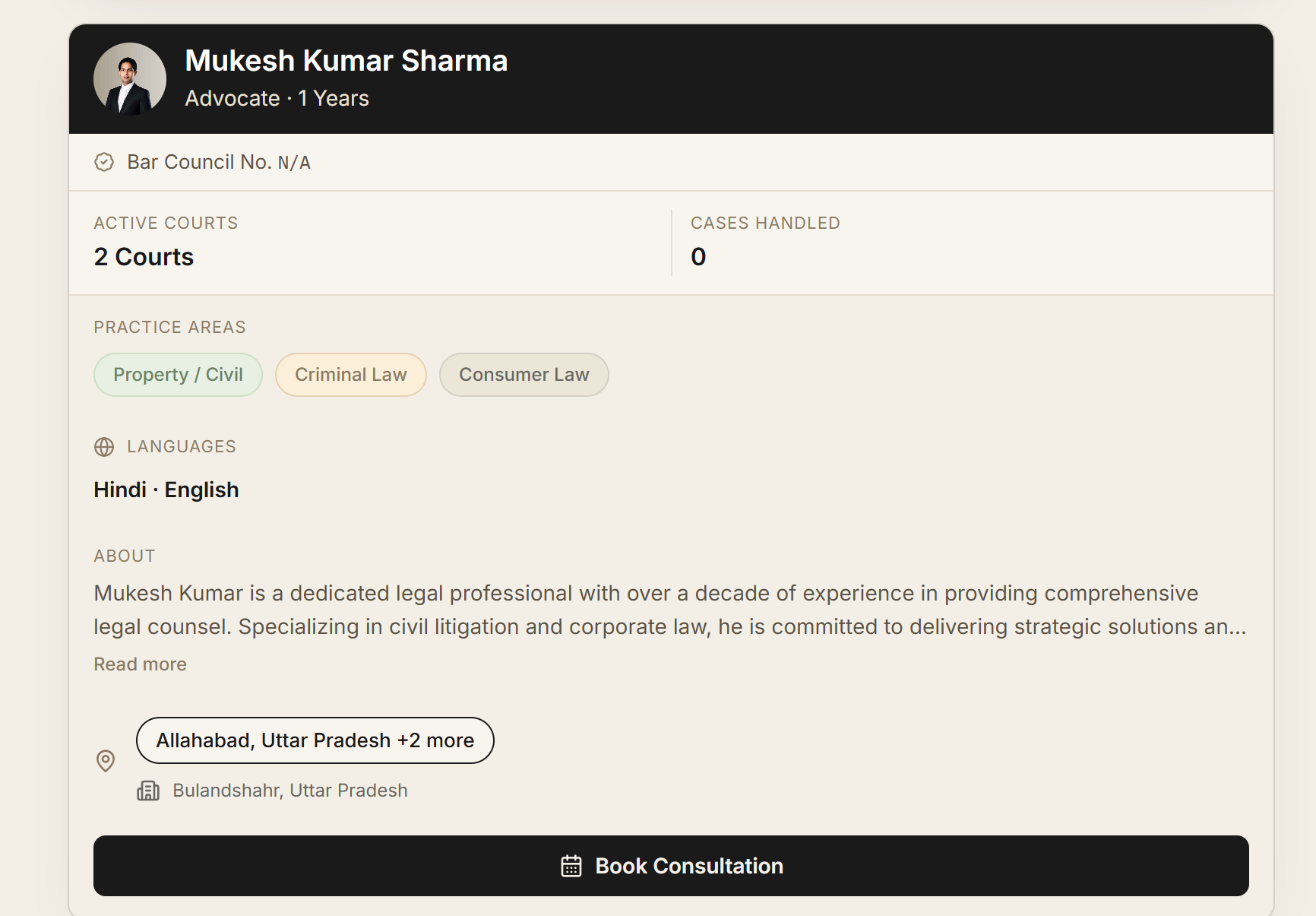
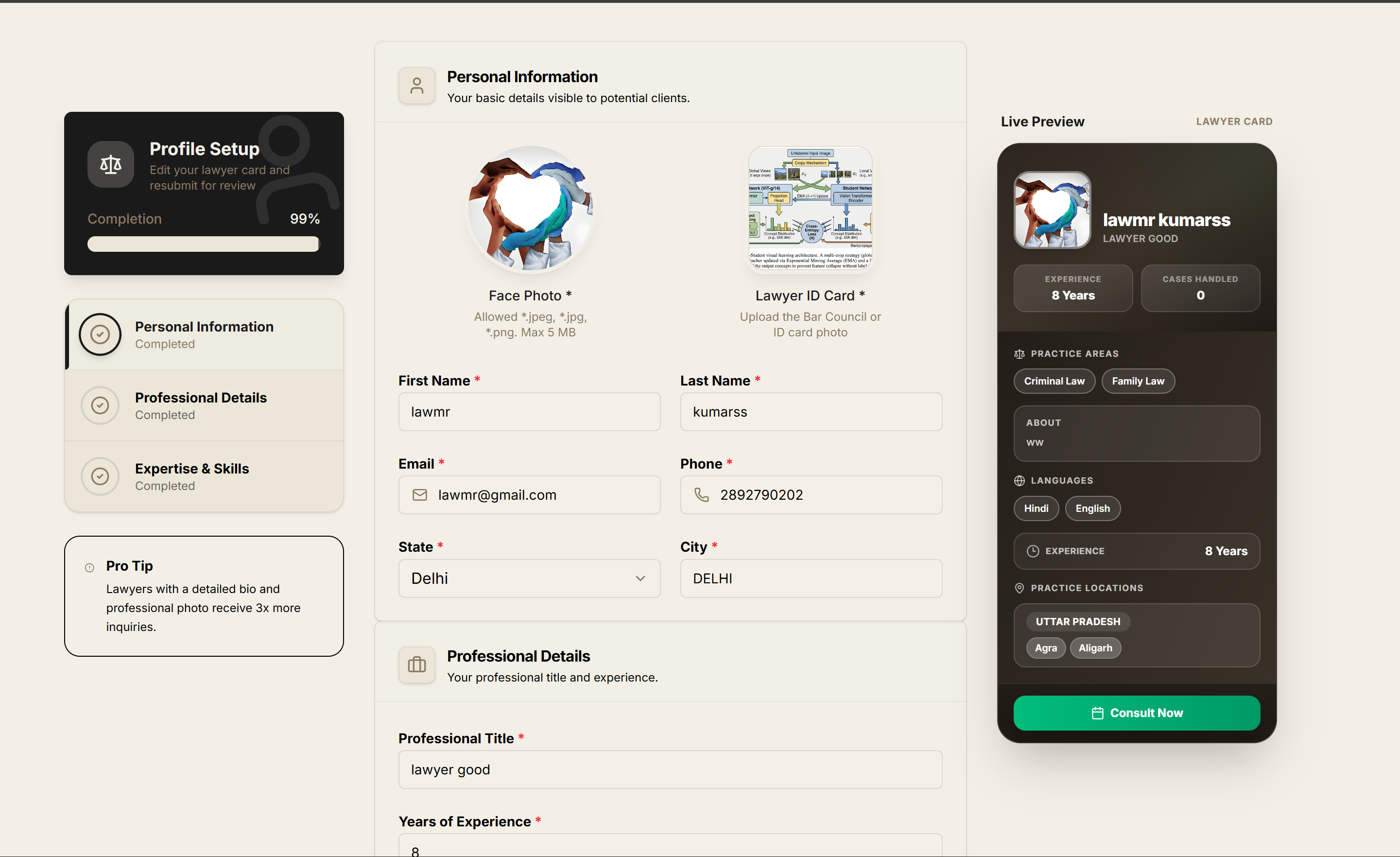
Build a professional advocate profile that helps clients across India discover your legal services. Showcase your Bar Council registration, specialisations, court appearances, and client reviews. Receive enquiries, manage bookings, and grow your practice digitally.
My verified profile on Judikit doubled my client inquiries in the first month. Clients across India can now discover my practice, read reviews, and book consultations directly.
Adv. Ramesh I., High Court Advocate, Chennai
Lawyer Profile & Digital Presence

Built for trust,
not just listings

How Judikit Works

Verified Lawyers

Every advocate is checked before they go live.

See the flow

Getting Matched

Cases reach the right lawyers, automatically.

See the flow

Private & Secure

Your case details stay between you and your lawyer.

See the flow

Organized Case Management

Every case, every message — one place.

See the flow

FAQs

Frequently
Asked Questions

Everything you need to know about finding and consulting with verified lawyers on Judikit.

How do I find a verified lawyer in India on Judikit?

Search by city, court, or practice area on Judikit to browse profiles of Bar Council-verified advocates. You can view their experience, practice areas, languages, and Bar Council registration number before reaching out.

Is Judikit free to use for finding a lawyer?

Yes, signing up, browsing advocate profiles, and searching is completely free. Judikit uses a coin-based system — you spend coins to register a case, and coins can be earned through platform participation or purchased via the Coin Market.

How does Judikit verify its lawyers?

Every advocate on Judikit is verified against their Bar Council of India or State Bar Council enrollment number before their profile goes live. Verified advocates display a badge on their profile.

What kind of legal cases can I get help with on Judikit?

Judikit lists advocates across practice areas including criminal law, family law, property and civil disputes, corporate law, consumer law, labour law, tax law, and cyber law.

How does the case registration process work on Judikit?

You describe your legal issue, provide your location and case details, and submit it. Your case is then sent to matching verified advocates who can review it and send you a proposal. You choose which advocate to work with.

What are coins and how do they work on Judikit?

Coins are Judikit's internal currency. You spend coins to perform actions like registering a case. You can earn coins by participating on the platform — completing mock tests, contributing templates, or winning predictions — or purchase them through the Coin Market.

Is my case information safe on Judikit?

Yes. Your case details are shared only with matching advocates or the specific advocate you choose. Private chat opens only after a proposal is accepted, and unrelated users cannot see your case.

Can law students use Judikit?

Yes. Judikit has a dedicated student section with internship listings, CLAT and AIBE preparation resources, quizzes, a legal clinic for practical experience, and a community forum for discussions.

What tools does Judikit offer besides finding a lawyer?

Judikit offers legal calculators (stamp duty, income tax, SIP, and more), an IPC-to-BNS section lookup tool, a judgment search engine, a Lok Adalat eligibility screener, a legal document template marketplace, and a community forum.

Can lawyers list their practice on Judikit?

Yes. Advocates can sign up, complete Bar Council verification, set up their profile with practice areas, languages, and locations, and receive case requests from citizens looking for legal help.

Our Blog

Indian law, plain language. What changed in 2026 and what it means for you. Property rights, criminal procedure, corporate compliance, consumer protection. No legalese, no fluff. Just things worth knowing whether you have an active case or not.

Get the Judikit App

Install our app for faster access, offline mode, and push notifications.

How the CJP Protest Sparked a Nationwide Debate on Students' Rights and Education Reform

The Cockroach Janta Party (CJP) protest has evolved beyond a single demonstration, triggering nationwide discussions on students' rights, examination transparency, public accountability, and education reform.

How the CJP Protest Sparked a Nationwide Debate on Students' Rights and Education Reform

The recent demonstrations led by the Cockroach Janta Party (CJP) have become one of India's most discussed student movements. What began as a protest against alleged irregularities in examinations has grown into a broader conversation about education policy, recruitment transparency, and the rights of students across the country.

The movement has attracted support from students, educators, and civil society groups who argue that systemic reforms are necessary to restore confidence in India's education and recruitment processes.

Why Students Are Joining the Movement

According to statements released during the protests, participants believe that education and competitive examinations should provide equal opportunities for every candidate.

The movement emphasizes that students invest years of preparation for competitive exams, making transparency and fairness essential to protecting their future careers.

Among the major concerns highlighted during the demonstrations are:

Peaceful Demonstrations Across Multiple Cities

Following the Parliament protest, demonstrations and awareness campaigns were reported in different parts of the country.

Participants carried banners, organized peaceful gatherings, and appealed to policymakers for structural reforms instead of temporary solutions.

The organizers repeatedly stated that their objective is to promote dialogue and encourage long-term improvements in the education system.

Constitutional Perspective

The movement has also generated discussions around constitutional rights.

Under Article 19(1)(a) and Article 19(1)(b) of the Constitution of India, citizens enjoy the freedoms of speech, expression, and peaceful assembly, subject to reasonable restrictions imposed in the interest of public order and public safety.

Legal experts note that public demonstrations play an important role in democratic societies by allowing citizens to raise issues of public concern through peaceful means.

Impact on Public Discourse

The CJP movement has shifted public attention toward several important issues:

The protests have also increased discussions on social media, with many students sharing their personal experiences regarding competitive examinations and recruitment delays.

Looking Ahead

Movement representatives have stated that future campaigns will focus on awareness programs, student engagement, and continued discussions with policymakers.

Whether these efforts lead to policy changes remains uncertain, but the protests have already succeeded in placing education reform at the center of the national conversation.

Key Takeaways

Conclusion

The Cockroach Janta Party's protests represent more than a response to examination-related concerns—they reflect a growing demand for fairness, accountability, and transparency in India's education and recruitment systems. As discussions continue between stakeholders, the movement is likely to remain an influential voice in shaping future debates on education policy and students' rights.